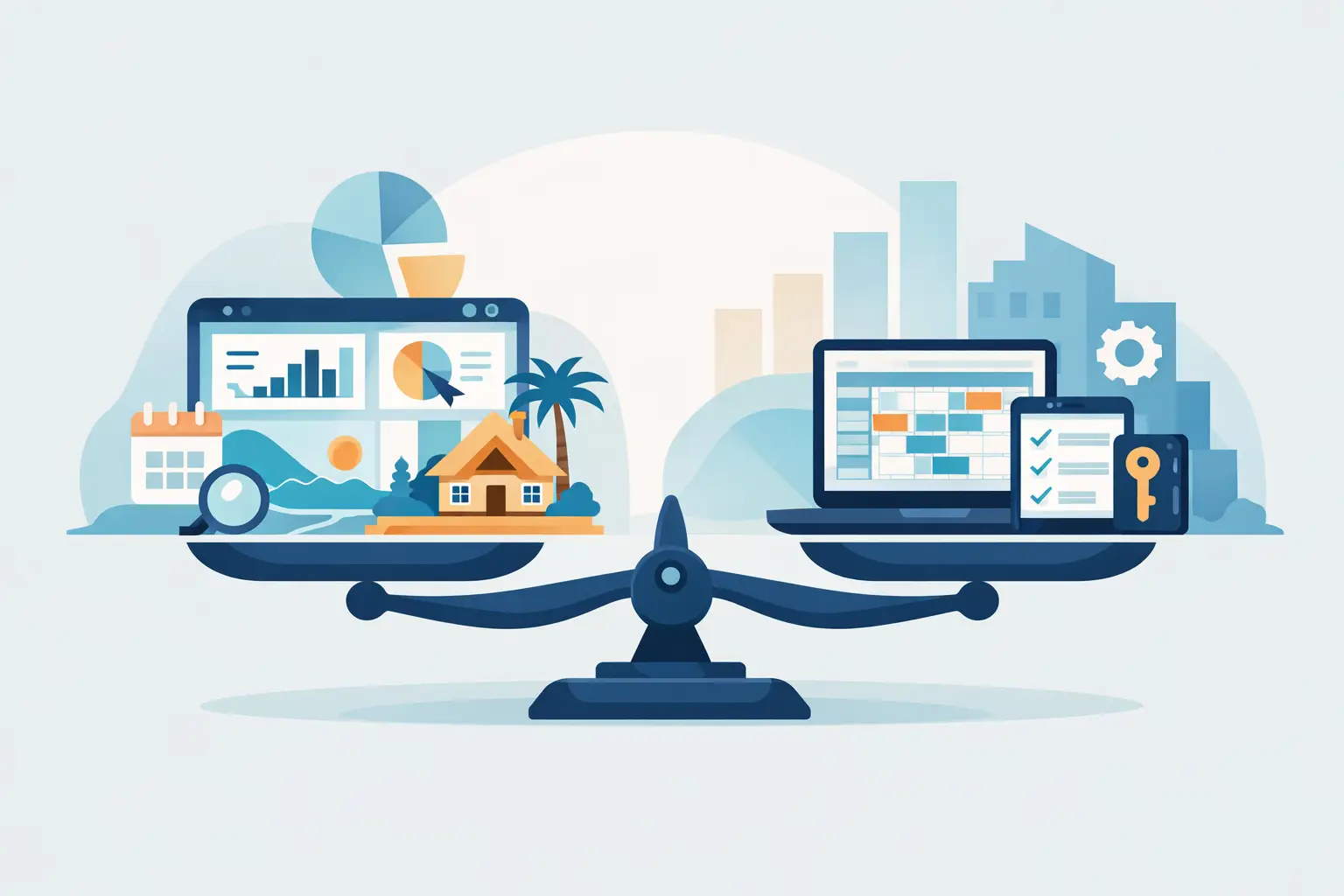
A missed cleaning task is visible. A slow booking pace is not always. That distinction sits at the center of the vacation rental dashboard vs PMS decision. Property management systems are built to run the operational engine. Dashboards are built to show what that engine is producing, where performance is slipping, and what deserves action next.
For a single property, the difference may feel minor. For a portfolio of villas, apartments, or boutique hospitality assets, it becomes strategic. Operators need both reliable execution and a clear view of revenue, occupancy, costs, guest patterns, and exceptions across every property.
Vacation Rental Dashboard vs PMS: Different Jobs
A PMS is the system of record for daily property operations. It typically manages reservations, calendars, guest messaging, check-in details, housekeeping coordination, channel distribution, payments, and owner statements. Its purpose is transactional control. When a guest books, a payment is processed, or a turnover is scheduled, the PMS records and coordinates that activity.
A vacation rental dashboard sits above those workflows. It turns operational, financial, and market data into a management view. Rather than asking, "Has the guest received check-in instructions?" it helps answer, "Which properties are underperforming this month, why, and what should change?"
The distinction matters because operational data alone does not automatically create operational intelligence. A PMS can contain thousands of reservations and still leave a portfolio owner manually comparing reports, spreadsheets, and channel data to understand actual performance.
What a PMS Does Well
For most professional operators, a PMS is non-negotiable. It creates the structure required to manage bookings accurately and consistently at scale. Its strengths are rooted in execution.
A capable PMS centralizes availability, reduces the risk of double bookings, routes reservations from multiple channels, and supports repeatable guest communication. It also gives teams a working environment for arrival preparation, task assignment, payment tracking, and issue resolution. These functions protect service quality and reduce the amount of manual coordination required from operations teams.
The PMS is particularly valuable when the immediate question is operational: Is the property ready? Has a balance been collected? Is a maintenance ticket open? Which guest arrives tomorrow?
But PMS reporting often reflects the architecture of the underlying system. Reports may be fragmented by module, channel, property, or date range. They can show what happened without clearly explaining the commercial significance of what happened. That is not a failure of the PMS. It is simply not the primary job it was designed to perform.
What a Vacation Rental Dashboard Adds
A dashboard gives leadership a shared performance layer. It brings high-value signals into one view so owners, revenue managers, and operations leads can evaluate the portfolio without rebuilding reports every week.
The strongest dashboards do more than display total revenue and occupancy. They make comparisons meaningful. A manager should be able to see whether lower revenue comes from weaker occupancy, shorter stays, lower average daily rate, blocked inventory, rising discounts, or a shift in booking lead time. Those are different problems with different responses.
For example, a coastal villa may be fully booked yet underperforming because rates were set too conservatively during a high-demand period. Another property may have a healthy average daily rate but insufficient occupancy because it is not converting for key dates. A PMS will record both outcomes. An intelligence-focused dashboard helps prioritize the right corrective action.
This becomes even more useful across mixed portfolios. A luxury villa in the UAE, a city apartment in the United States, and a boutique property in Spain should not be evaluated with identical assumptions. Portfolio visibility needs to preserve property-level context while still giving leadership a consistent basis for comparison.
The Real Decision Is Not Dashboard or PMS
Treating this as an either-or choice creates the wrong architecture. A PMS and dashboard serve complementary roles: one runs the property, while the other helps run the business.
The better question is whether your existing operational stack gives decision-makers timely, trustworthy answers. If monthly reporting requires exports from the PMS, reconciliation in spreadsheets, and separate checks across booking channels, the business has data but lacks a practical intelligence layer.
That gap becomes more expensive as a portfolio grows. Manual reporting introduces delays and inconsistent definitions. One team member may calculate occupancy based on available nights, while another uses total calendar nights. Revenue may be gross booking value in one report and net accommodation revenue in another. Decisions made from mismatched numbers are difficult to defend.
A dashboard establishes a clearer operating language. It can standardize the metrics that matter and keep attention on movement, variance, and action rather than on report assembly.
Metrics That Need More Than a Standard Report
Not every metric deserves executive attention. The value comes from connecting measures that reveal how the business is performing and where management intervention will have the greatest impact.
Revenue, occupancy, average daily rate, and RevPAR remain foundational. But they become more useful when viewed by property, market, booking channel, stay date, and booking window. A portfolio may appear healthy at the total level while several high-value assets fall behind their expected pace.
Operational metrics matter too. Cleaning turnaround time, maintenance volume, response time, guest issue categories, and calendar blocks can expose risks that revenue reports miss. If a property loses bookable nights to recurring maintenance or delayed turnover, that is both an operating issue and a revenue issue.
For owners and investment professionals, profitability requires an additional layer. Gross revenue alone can hide rising distribution costs, high operational spend, or inconsistent contribution by property. A useful dashboard should support discussions about yield, not just booking volume.
When a PMS May Be Enough
A dashboard is not automatically necessary for every operator. A small portfolio with stable demand, limited channels, and hands-on ownership may get sufficient visibility from PMS reports and a disciplined monthly review. Adding another platform only makes sense if it reduces friction or improves the quality of decisions.
The case changes when reporting is manual, properties vary significantly, teams are accountable for revenue targets, or owners need a transparent view of results. It also changes when the portfolio is expanding into new regions, property types, or distribution strategies. More complexity creates more places for performance gaps to hide.
The best test is practical: Can your team identify yesterday's operational exceptions and this month's commercial risks without assembling data from multiple sources? If the answer is no, a dashboard is likely becoming an operating requirement rather than a reporting convenience.
Selecting an Intelligence Layer
A useful dashboard must be trusted before it can be acted on. Start with data coverage. It should connect reliably to the systems that hold reservations, rates, costs, tasks, and guest activity. Partial visibility produces confident-looking but incomplete conclusions.
Next, evaluate the level of detail behind each metric. Leadership needs concise portfolio views, but managers also need to move from a headline number into the properties, dates, channels, or cost drivers causing it. A red indicator without diagnostic context only shifts analysis back into spreadsheets.
Finally, look for actionability. The platform should make variance visible, surface exceptions early, and support the cadence your business actually uses: daily operations checks, weekly pace reviews, and monthly owner or investment reporting. VillaPilot AI is designed around this intelligence layer, helping professional operators turn fragmented property signals into a clearer basis for control.
Build for Decisions, Not Just Reporting
The strongest technology stack does not produce the most dashboards. It gives the right person a reliable answer before a minor issue becomes lost revenue, a guest-service failure, or an avoidable cost.
Keep the PMS at the center of execution. Add a vacation rental dashboard when the business needs a wider lens: one that connects property activity to commercial performance and turns visibility into a disciplined next decision.