A property data consolidation example becomes valuable when it changes a decision, not when it simply puts more dashboards in front of an operator. For a villa portfolio, the goal is to connect commercial, operational, and guest data around the same property and stay. That creates a working view of performance: what is earning, what is at risk, and where a team should act next.
The operating problem behind fragmented property data
A professional villa operator may have a property management system managing reservations, several OTAs reporting channel activity, a dynamic pricing tool adjusting rates, accounting software tracking payouts, and maintenance requests living in a separate workspace. Each system answers a valid question. None, on its own, explains the full operating position of a property.
This fragmentation creates expensive blind spots. A revenue manager can see that a villa's occupancy is behind plan, but not that two peak-date bookings were canceled after a recurring air-conditioning issue. An owner can see gross booking revenue, but not the commission, refund, maintenance, and payment-processing costs needed to understand net contribution. An operations lead may know a team is busy, but cannot see which issues threaten arriving guests or future reviews.
The challenge is not a lack of data. It is the absence of a shared property-level model that turns data into comparable operational intelligence.
A property data consolidation example: 24 villas, one decision layer
Consider a management company operating 24 high-value villas across a resort market. The portfolio uses a PMS for reservations and guest records, Airbnb and Vrbo for distribution, a direct booking engine, a rate-management system, accounting software, and a field-service tool for maintenance and housekeeping.
Before consolidation, the weekly portfolio meeting is manual. The revenue manager exports occupancy and ADR by channel. Finance reconciles payouts later in the month. Operations reviews maintenance tickets separately. Owners receive reports that are accurate but delayed, and exceptions are discovered through messages rather than a defined process.
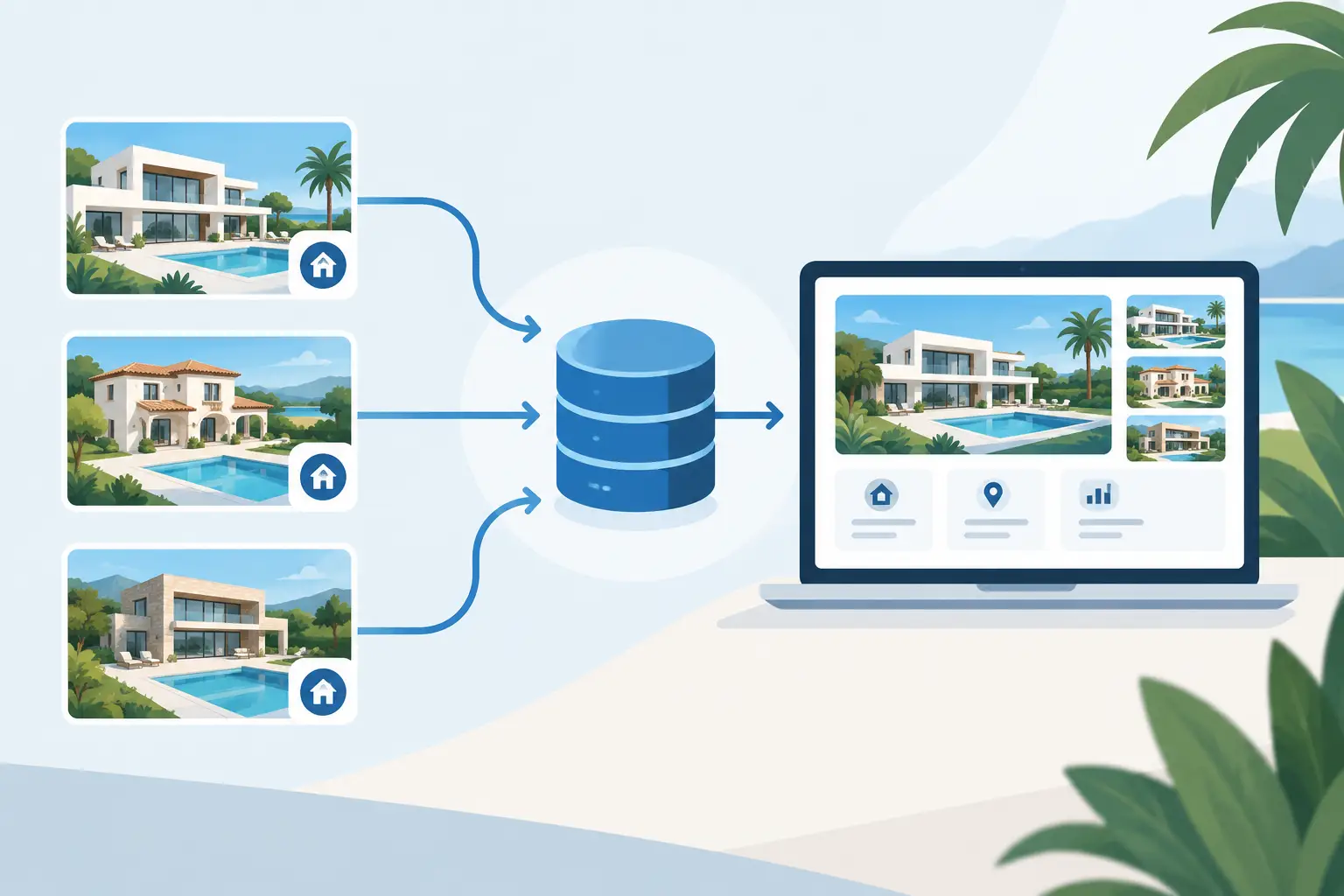
The company creates a centralized property intelligence layer. Every source is mapped to a consistent property ID, unit name, owner entity, reservation ID, and reporting period. Instead of treating records as disconnected exports, the system relates them to the same operational reality.
Four data groups form the core model:
- Reservation and channel data: booking dates, stay dates, rate, fees, cancellation status, lead time, source, and guest count.
- Availability and pricing data: open nights, blocked nights, minimum-stay rules, rate changes, and channel parity.
- Financial data: gross rent, owner revenue, OTA commissions, refunds, taxes, payment fees, and maintenance costs.
- Operational and guest data: work orders, issue category, time to resolution, clean status, guest complaints, review scores, and service recovery costs.
The point is not to force every system into one database for its own sake. The point is to produce a consistent answer when the business asks, “What happened at Villa 12, what did it cost, and what should we do?”
What the consolidated view reveals
In the first month, Villa 12 appears healthy in the PMS. It has 71% occupancy, a strong average daily rate, and more gross booking revenue than the prior month. A conventional report would classify it as a top performer.
The consolidated view tells a different story. Two bookings during a premium holiday window were canceled within 48 hours of arrival. Maintenance records show unresolved cooling issues preceding both cancellations. Guest messages identify the same issue in an earlier stay. Finance data shows one partial refund, two rate concessions, and an emergency vendor call-out. The pricing system had also reduced rates for the final open nights after the cancellations.
Gross revenue remained strong because earlier bookings carried the month. Net contribution and forward-looking risk did not. The operator can now classify the issue correctly: this is not a revenue-management problem. It is an asset reliability problem with a revenue consequence.
That distinction matters. Lowering rates may fill a vacancy, but it does not prevent another disruption. The right action is to prioritize the repair, block affected inventory if necessary, review the vendor response, and protect future high-value dates. Revenue, guest experience, and operations are connected through the same property record.
Build the model around decisions, not software categories
Consolidation projects often fail because teams start with integrations instead of use cases. They connect everything available, create a large reporting environment, and still cannot answer the questions that drive action.
Start with the decisions that recur every week. A portfolio operator may need to identify properties falling behind revenue pace, arriving guests exposed to unresolved service issues, owner statements with unusual cost variance, and availability that is blocked without a commercial reason. Those decisions define the data that must be joined and the speed at which it needs to update.
For example, a same-day arrival risk view needs current housekeeping status, maintenance severity, reservation details, and guest service notes. A monthly owner performance view needs finalized booking revenue, adjustments, expenses, and comparable prior-period results. These are different products with different refresh requirements. Treating both as a generic dashboard weakens each one.
Define one source of truth for each field
A centralized model does not mean every source is equally authoritative. The PMS may be the source of truth for reservation status and stay dates. The accounting platform may be authoritative for settled payouts and recorded expenses. The maintenance system may own work-order completion time.
This governance prevents familiar reporting disputes. If a canceled booking remains in a channel export but is marked canceled in the PMS, the model needs a clear rule for which status controls reporting. If villa names vary by channel, the system needs a maintained mapping rather than a spreadsheet correction repeated every month.
Property identifiers deserve particular attention. A portfolio might refer to the same asset as “Casa 14,” “C14 Beach Villa,” and an internal owner code. Without a canonical property ID, performance can be split across records and the resulting intelligence will look precise while being wrong.
Preserve timing and change history
Vacation rental operations move quickly. Availability changes, reservations cancel, rates adjust, and tickets reopen. A useful intelligence layer should retain both the current state and the time of change.
This makes it possible to ask better questions: Did a rate adjustment improve booking pace? How long was the villa unavailable before a maintenance issue was resolved? Did a service disruption occur before or after the guest requested a refund? Without timestamps and history, teams can report outcomes but cannot reliably diagnose causes.
Measure what commercial performance actually means
Occupancy and ADR remain useful, but they are incomplete in a high-service villa business. A consolidated model should also show net revenue after distribution costs, contribution after direct operating costs, cancellation exposure, maintenance-related downtime, booking pace against comparable periods, and service incidents per occupied stay.
The appropriate metric depends on the decision. For an owner reviewing investment performance, net owner revenue and controllable expenses may matter most. For a revenue manager, forward occupancy, average booking window, and open high-demand nights may be more actionable. For operations, unresolved arrival-critical tickets and time to resolution deserve priority.
There are trade-offs. More granular financial allocation provides a truer view of property profitability, but it requires disciplined coding and reconciliation. Near-real-time data supports faster intervention, but preliminary figures may differ from settled accounting records. The right design labels data freshness and financial status clearly instead of presenting every number as final.
Turn exceptions into operating workflows
The strongest consolidation programs do not stop at visibility. They define what happens when a signal crosses a threshold.
If a premium property has an unresolved critical maintenance ticket within 24 hours of arrival, the system should surface the responsible team, reservation value, guest profile, and next action. If a villa has a sudden rise in cancellations, the operator should be able to inspect cancellation reasons, pricing movement, listing changes, and recent guest feedback in one place.
This is where a platform such as VillaPilot AI shifts the work from retrospective reporting to decision support. The value is not another static scorecard. It is a prioritized operating view that connects a signal to the property, financial impact, and accountable response.
Start narrow, then expand with discipline
A practical first release does not need to solve every data problem. Begin with a portfolio view that combines reservations, availability, and operational exceptions for the properties that generate the most revenue or create the most service complexity. Validate property mappings, reporting rules, and owner-facing calculations before extending the model.
Once the foundation is reliable, add deeper finance, guest sentiment, vendor performance, and forecasting. This sequence is usually faster than attempting a complete enterprise data project upfront, because teams learn which fields actually influence decisions.
The most useful property intelligence is not the system with the most connected data. It is the one that lets a portfolio team spot a preventable problem early enough to protect a stay, a review, and the revenue attached to both.