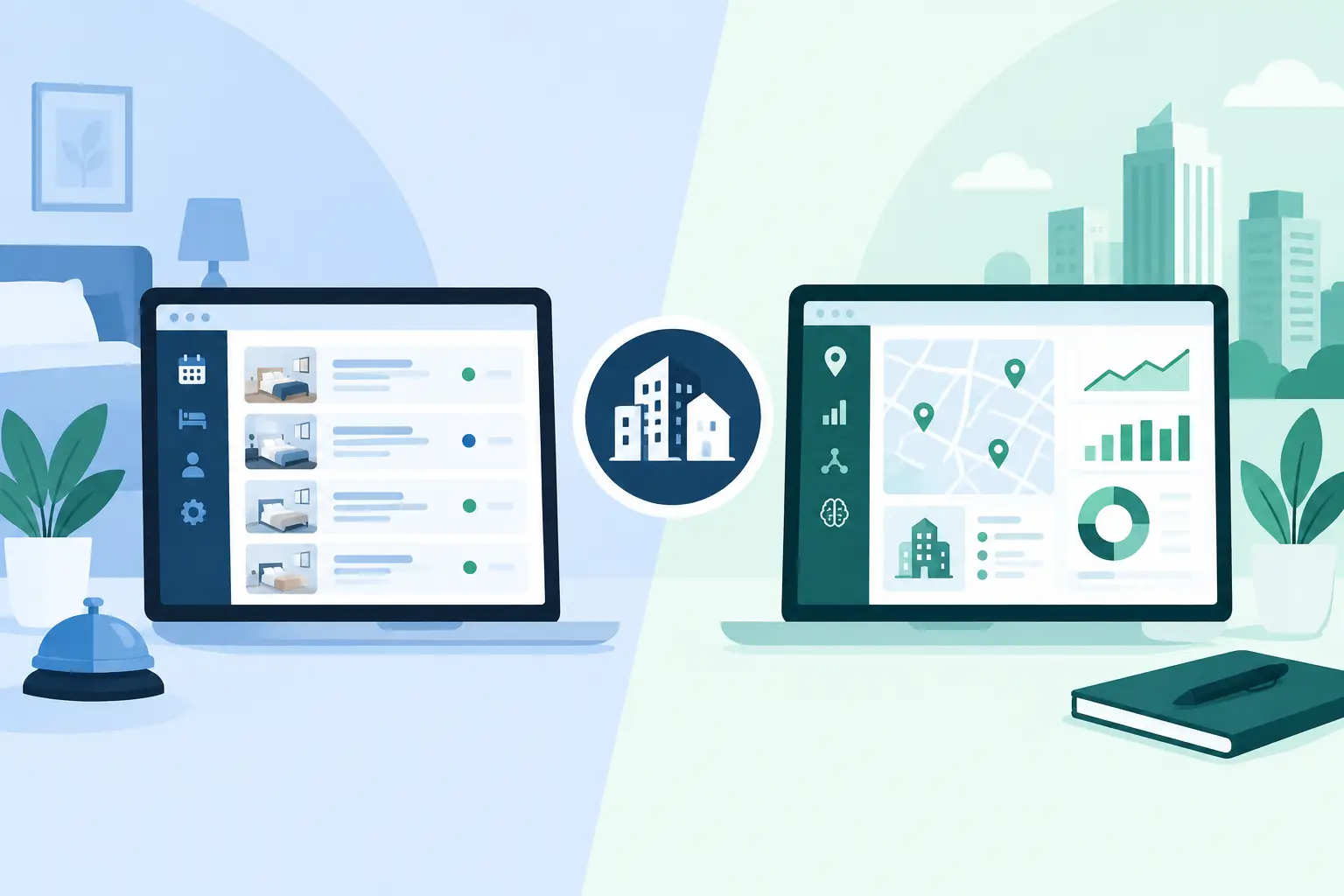
A portfolio can be fully managed and still be poorly understood. Reservations may flow, housekeeping tasks may close, and owner statements may go out on time, yet leadership can remain unable to answer a more valuable question: which properties are gaining momentum, which are losing margin, and why? That is the practical distinction behind PMS versus property intelligence platforms. One records and coordinates operational activity. The other turns the signals created by that activity into direction.
For villa operators, short-term rental managers, and hospitality groups with multiple assets, this is not a debate about replacing functional software. It is about recognizing that operational control and business intelligence solve different problems. A property management system is foundational. But it is not automatically a decision system.
What a PMS Is Designed to Do
A property management system, or PMS, is the operational system of record. It typically centralizes reservations, availability, rates, guest details, calendars, payments, housekeeping, maintenance, and channel connections. Its job is to keep the property business moving without relying on disconnected spreadsheets, inboxes, and manual updates.
That capability matters. A professional operator needs accurate booking records, coordinated inventory, consistent guest communications, and clear task ownership. Without a reliable PMS, teams spend too much time reconciling basic facts: Is the villa available? Has the payment been collected? Is the turnover complete? Did the guest receive the check-in instructions?
The PMS is built to answer questions about execution. What is booked? What needs to happen next? Who owns the task? What information should be sent to the guest or owner?
For a single property or a small, stable portfolio, those answers can cover most day-to-day needs. The limitations become more visible as the operation adds properties, markets, channels, staff, and owner expectations.
Where PMS Reporting Often Reaches Its Limit
Most PMS platforms offer dashboards and reports. That does not make them property intelligence platforms.
Reporting usually presents historical operational data: occupancy, revenue, booking pace, source mix, cancellations, and average daily rate. These figures are useful, but they often require someone to interpret them manually, compare them against targets, reconcile them with other systems, and decide whether action is required.
The challenge is not a lack of data. It is the distance between data and a confident operating decision.
Consider a manager who sees that monthly revenue is up. That headline may conceal an unhealthy trend. Revenue may have increased because more nights were sold at a lower rate. One high-performing villa may be carrying several underperforming assets. Distribution costs may be rising faster than booking value. A drop in guest satisfaction could be increasing refund risk before it appears in financial reporting.
A PMS can contain many of these inputs. It may not connect them into a clear explanation of performance or prioritize what needs attention. That work often shifts to spreadsheets, business intelligence tools, revenue meetings, and the experience of a small number of senior operators.
This creates a familiar scaling problem: the portfolio grows, but strategic visibility does not grow at the same pace.
PMS Versus Property Intelligence Platforms: The Core Difference
The simplest distinction is this: a PMS helps teams run properties; a property intelligence platform helps leaders understand and improve the business those properties create.
A property intelligence platform sits above fragmented operational data and gives it commercial context. It can consolidate information across properties, booking channels, teams, financial periods, and performance indicators. Rather than asking users to search through reports, it identifies patterns, exceptions, trends, and opportunities that require a decision.
The platform should help an operator move from a raw metric to a useful question. Occupancy is down becomes: Is the decline isolated to a market, a property type, a booking window, or a distribution channel? Revenue per available night is behind target becomes: Is pricing the issue, is demand weak, or is availability being constrained by operations? Guest feedback slips becomes: Which recurring operational factors are affecting the stay?
This is why intelligence is not simply a more polished dashboard. A dashboard shows information. Intelligence provides context, comparison, prioritization, and a path toward action.
For portfolio owners, this distinction can be particularly valuable. They do not need another screen full of reservation detail. They need a reliable view of asset performance, operating risk, revenue potential, and the decisions that deserve attention first.
From Activity Tracking to Decision Support
A PMS is generally transaction-led. It tracks events as they occur: a reservation is created, a payment is processed, a task is assigned, a guest message is sent. These records are essential because they form the operating history of the business.
A property intelligence platform is outcome-led. It evaluates what those events mean at the property, portfolio, and commercial level. It can highlight whether operational activity is producing the desired outcome or merely keeping teams busy.
That distinction changes how management meetings work. Instead of reviewing every property in sequence, leaders can focus on exceptions: assets with weakening booking pace, unusual cancellation behavior, declining conversion, inconsistent rates, maintenance patterns, or missed revenue potential. Teams spend less time compiling updates and more time resolving the issues that affect performance.
The benefit is not automation for its own sake. It is better allocation of management attention. In a high-value villa portfolio, a missed pricing adjustment or unresolved service issue can matter more than dozens of routine tasks completed correctly. Intelligence helps separate signal from operational noise.
When a PMS Is Enough, and When It Is Not
A PMS may be enough when the operation is small, the portfolio is relatively uniform, reporting requirements are simple, and an experienced operator can review performance manually without delay. It can also be enough when the immediate priority is establishing basic operational discipline.
The case for a property intelligence layer strengthens when there are multiple properties, varied locations, several booking sources, complex owner reporting, or a need to improve revenue performance systematically. It becomes more compelling when leadership depends on spreadsheets to compare assets, identify weak points, or prepare decisions for owners and investors.
There is also a timing factor. An operator does not need to wait until reporting has become unmanageable. Intelligence is most effective when it is built into management habits before fragmentation becomes the default operating model.
That said, platform choice should reflect the quality of the underlying data. Intelligence cannot compensate for inaccurate property setup, inconsistent task completion, unreliable financial inputs, or disconnected systems that do not share usable information. A PMS remains critical. The stronger the operational foundation, the more valuable the intelligence built on top of it.
What to Evaluate Beyond Features
When assessing a property intelligence platform, feature lists can distract from the more important question: will this system improve the decisions your team makes each week?
Look for a platform that can create a consistent view across the portfolio rather than forcing users to interpret separate reports property by property. It should make comparisons meaningful, accounting for differences in seasonality, property type, market behavior, and operating model. A villa in Miami, a coastal home in Mexico, and an urban hospitality asset in Europe may not share the same demand pattern, but leadership still needs a common framework for evaluating performance.
The platform should also be actionable. A revenue alert without context is not enough. Teams need to understand the size of the opportunity, the likely driver, the affected assets, and who should respond. Similarly, operational visibility should not become surveillance theater. It should show where service delivery, cost control, or execution may be affecting commercial results.
Finally, evaluate adoption. Senior managers need strategic clarity, while operations teams need practical relevance. The best intelligence layer makes both groups more effective without creating another reporting burden.
Intelligence Becomes a Management Advantage
The real value of property intelligence is not that it produces more data. It creates a more disciplined relationship with the data already generated by the business.
For operators managing premium stays, that discipline protects both revenue and reputation. It helps teams identify performance gaps before they become owner concerns, detect operational patterns before they affect reviews, and direct attention toward the properties and decisions with the greatest commercial impact.
A PMS keeps the operation organized. A property intelligence platform helps keep the operation accountable to its potential. As portfolios become more complex, the advantage belongs to the teams that can see clearly enough to act before the monthly report explains what went wrong.