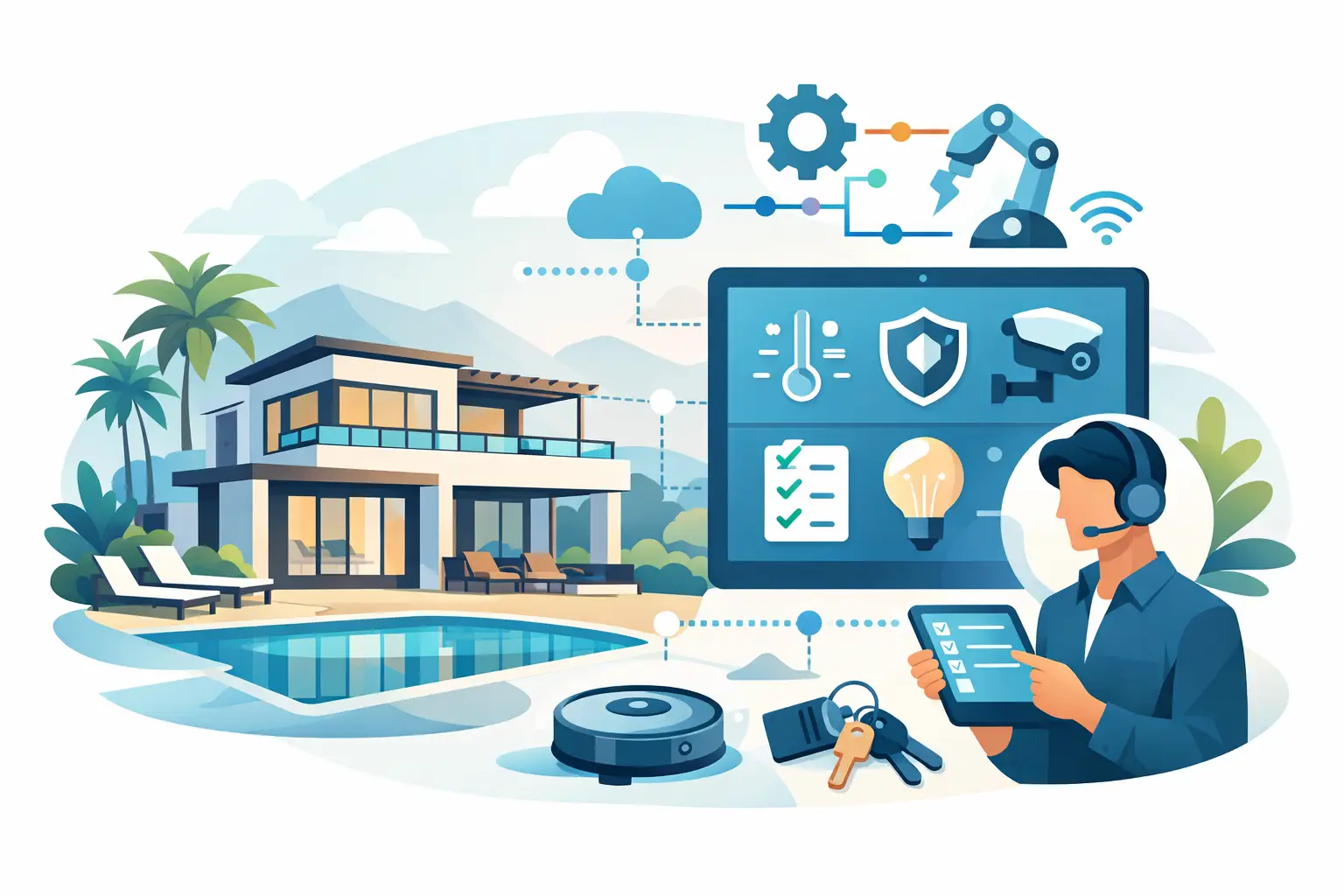
A missed cleaning update at 11:30 a.m. can delay check-in, trigger guest complaints, and force your team into manual damage control before the day has properly started. That is usually the moment operators start asking how to automate villa operations without creating more software, more noise, or less accountability.
For professional villa managers, automation is not about replacing service. It is about removing repeatable friction from high-stakes operations. The real objective is tighter control across reservations, housekeeping, maintenance, guest communication, vendor coordination, and performance reporting. If your portfolio relies on staff chasing updates across texts, spreadsheets, inboxes, and disconnected tools, the issue is not effort. It is system design.
How to automate villa operations without losing control
The most common mistake is automating tasks one by one without fixing the operating model underneath. A smart villa operation does not start with a chatbot or a digital lock. It starts with identifying which decisions are routine, which workflows are repeatable, and which exceptions still need human review.
In practice, villa operations usually break into three layers. The first is execution, such as assigning cleans, sending check-in instructions, or flagging maintenance. The second is coordination, which includes timing, handoffs, approvals, and visibility across teams. The third is intelligence, meaning the ability to see what is happening across properties and act before a small issue becomes an operational problem.
If you automate only execution, you may save time but still operate reactively. If you automate coordination and add intelligence on top, you gain operational leverage.
Start with process mapping, not software
Before adding any new platform, map your current workflows from booking to checkout. Look for moments where your team repeats the same action, waits for information, or manually reconciles data between systems. Those are the first candidates for automation.
For most villa operators, the clearest opportunities appear in guest messaging, housekeeping scheduling, maintenance triage, owner reporting, and occupancy-based task assignment. But not every process should be automated to the same degree. A pre-arrival message is predictable. A last-minute plumbing issue at a premium property is not.
This is where many teams over-automate. They push too much into rigid workflows and then create workarounds for edge cases. A better approach is to automate the standard path and define escalation rules for exceptions. That keeps the system efficient without making it blind.
The systems that matter most
When operators ask how to automate villa operations, they often think in terms of tools. The better lens is systems architecture. You need one operational environment where booking data, task status, property issues, guest events, and performance signals can be viewed together.
At a minimum, automation depends on accurate source data. If your reservation data is inconsistent, housekeeping automations will fail. If maintenance updates live in a separate channel, property readiness becomes guesswork. If owner reporting is assembled manually at month-end, there is no real-time oversight.
That is why centralization matters. Automation performs best when data from PMS activity, team workflows, revenue inputs, and property events is normalized into one operating layer. This is also where intelligence platforms create more value than standalone point solutions. They do not just trigger actions. They help operators understand what is changing across the portfolio and where attention is needed.
Automate guest operations first
Guest-facing workflows are often the easiest place to begin because they are high-frequency and highly structured. Booking confirmations, pre-arrival instructions, check-in guidance, upsell prompts, mid-stay support routing, and checkout reminders can all be automated with clear rules.
The benefit is not just labor savings. It is consistency. High-value villa guests expect timely, accurate communication. A delayed message feels operationally sloppy, even if the stay itself is excellent. Automated guest workflows reduce those misses.
That said, tone and timing matter. Luxury and boutique villa brands should not automate communication in a way that feels generic or transactional. The right setup uses automation to guarantee responsiveness, while preserving the option for human intervention when the guest profile, stay value, or service issue calls for it.
Housekeeping and turnover automation drive immediate gains
If your turnovers are coordinated manually, there is usually hidden waste in the schedule. Cleaners wait for confirmation, supervisors chase completion updates, and operations teams lack a clear readiness view until close to arrival time.
Automation can solve this by triggering task creation based on reservation events, assigning teams based on location or property rules, and updating status in real time as work is completed. Add inspection checkpoints and escalation alerts, and the operation becomes far more predictable.
This matters even more across multi-property portfolios. Manual turnover coordination may still function at five villas. At 20 or 50, it becomes a scaling constraint. Automated scheduling and status visibility create capacity without expanding administrative overhead at the same rate.
Maintenance should be automated, but not flattened
Maintenance is where many operators hesitate, and for good reason. Not every issue deserves the same workflow. A low battery alert, HVAC anomaly, water leak, and cosmetic repair request should not enter the system as identical tickets.
The smarter model is automated intake with tiered routing. Issues can be categorized by urgency, asset type, guest impact, and property priority. That allows the system to route minor issues into standard queues while escalating higher-risk events immediately.
This is also where AI has practical value. Instead of simply logging maintenance events, an intelligent platform can surface repeat incidents, identify patterns by property, and help operators prioritize root-cause fixes over repetitive patchwork. That changes maintenance from reactive work into asset protection.
Reporting is one of the most overlooked automation wins
Many villa businesses still run on delayed visibility. Teams execute tasks all week, then leadership gets a partial view through static reports or fragmented dashboards. That delay limits decision quality.
Automated reporting changes the pace of management. Revenue performance, task completion, maintenance backlog, guest sentiment, and property-level anomalies can be surfaced continuously instead of compiled after the fact. This is especially important for portfolio owners and operators managing premium inventory, where a small issue at one property can have an outsized commercial effect.
For decision-makers, the value of automation is not only that tasks happen faster. It is that operating data becomes usable while there is still time to act on it.
How to automate villa operations in phases
The strongest rollouts are phased. Start with one or two high-volume workflows where inputs are clean and outcomes are easy to measure. Guest messaging and housekeeping are usually good starting points. Then move into maintenance coordination and performance reporting.
This staged approach does two things. First, it reduces implementation risk. Second, it gives your team time to adapt to a new operating rhythm. Automation changes accountability as much as process. Staff no longer spend time chasing status updates, which means managers need clearer exception handling, stronger SOPs, and better visibility into actual performance.
If you try to automate everything at once, adoption usually breaks before the technology does.
The trade-off: efficiency versus flexibility
There is no perfect automation model for every villa operation. A luxury operator with white-glove service expectations may intentionally keep more human checkpoints in the guest journey. A fast-scaling short-term rental group may prioritize standardization and speed. A mixed portfolio may require different automations by property tier.
That is why rigid templates rarely hold up. The right system reflects your operating complexity, service model, and portfolio structure. Automation should reduce manual drag, not erase the judgment that protects brand standards.
A platform approach is usually the best fit for professional operators because it supports both automation and oversight. VillaPilot AI, for example, fits this shift by adding intelligence across fragmented property workflows rather than treating automation as a set of isolated triggers.
What good automation actually looks like
Good automation is not flashy. It is quiet, reliable, and visible. Reservations trigger the right tasks. Teams know what is done and what is delayed. Guest communication happens on time. Issues are escalated based on impact. Leadership sees portfolio performance without asking three people for updates.
That is the standard worth aiming for. If your current operation depends on manual coordination to stay functional, automation is not a future upgrade. It is the infrastructure required to scale with control.
The best time to automate villa operations is usually before growth exposes every weak handoff in your system. If you build the intelligence layer early, expansion stops feeling like operational strain and starts looking like a manageable signal problem.