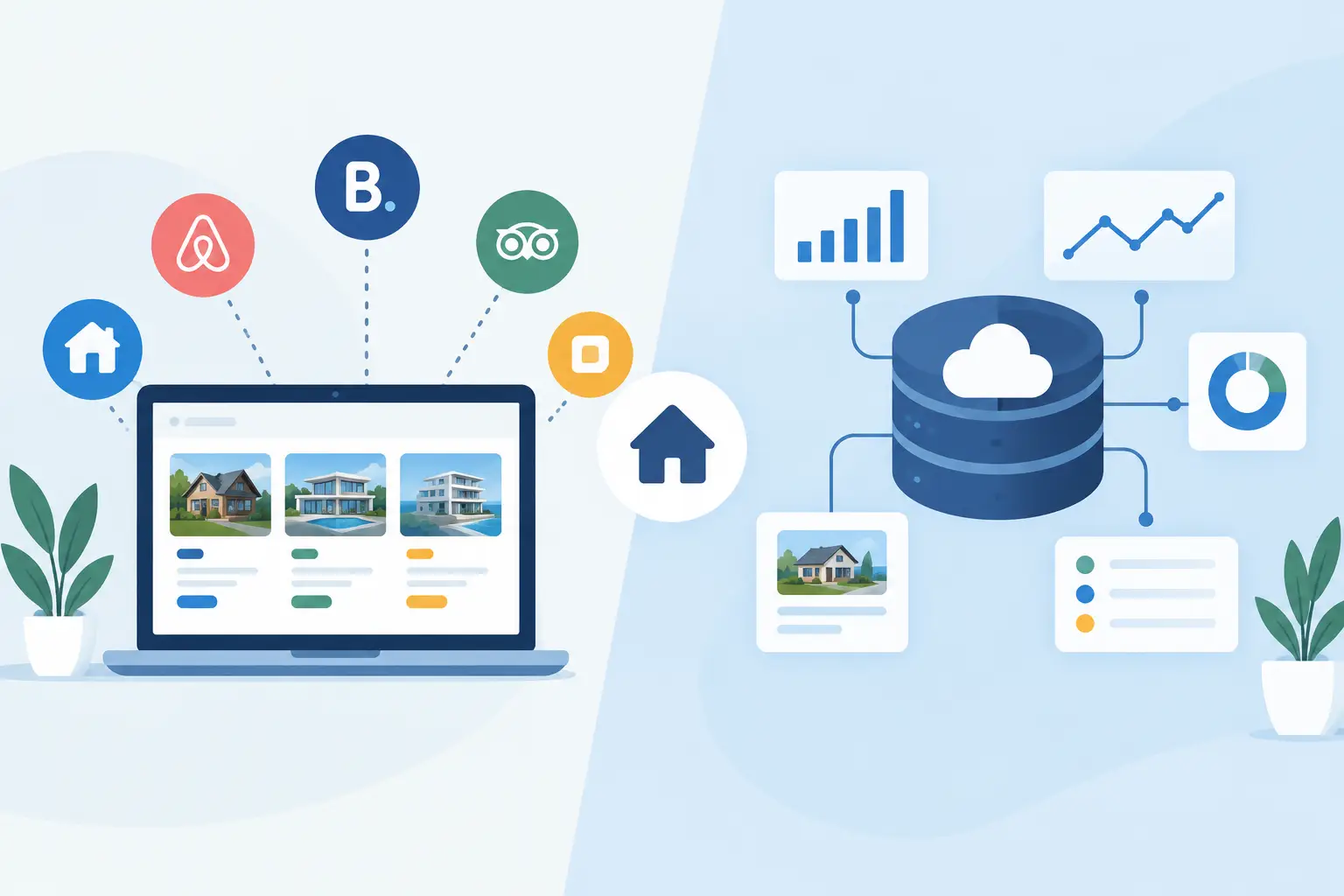
A channel manager vs data platform decision is often framed as a software comparison. For a growing vacation rental portfolio, it is really a decision about control. One tool keeps inventory and bookings aligned across sales channels. The other turns property, operational, guest, and market data into a clearer view of what is working, what is slipping, and where management attention should go next.
The distinction matters most once a portfolio has moved beyond a handful of properties. At that stage, distribution errors are costly, but so are decisions made without context: rates held too low during compression, underperforming villas hidden inside portfolio averages, maintenance issues that quietly affect reviews, or teams spending hours reconciling reports that should already agree.
Channel manager vs data platform: different jobs
A channel manager is a distribution system. It connects a property management system or booking engine to online travel agencies and listing channels. Its central task is to synchronize availability, rates, restrictions, and reservation details. When a guest books through one channel, the channel manager updates the others to help prevent double bookings.
That function is essential. For operators selling through Airbnb, Vrbo, Booking.com, direct booking sites, regional marketplaces, or a mix of channels, manual inventory updates are not a serious operating model. A channel manager reduces repetitive work, protects availability accuracy, and helps managers maintain a consistent commercial presence across their booking network.
A data platform has a broader mandate. It brings together information from systems that typically operate in isolation: PMS records, channel performance, reservations, pricing, owner reporting, guest communications, task completion, reviews, costs, and operational events. It then structures that information into usable intelligence.
The difference is not that one is better in every scenario. A channel manager answers, "Did the right inventory and rate reach the right channel?" A data platform is built to answer questions such as, "Why is this property trailing comparable assets?" "Which channel produces the highest-value stays after cost?" "Where are operational failures putting future revenue at risk?" and "What should we change this week?"
Distribution is not portfolio intelligence
Many operators expect their channel manager to become the center of their technology stack because it touches bookings. This is understandable, but bookings are only one layer of property performance.
Channel-level revenue does not automatically reveal profitability. A property can appear to perform well on gross booking value while carrying high commission costs, excessive discounting, frequent service recovery, or short stays that raise turnover expenses. Likewise, strong occupancy can mask weak average daily rate, poor owner returns, or missed direct booking opportunities.
A channel manager records the transaction and distributes the inventory. It is not usually designed to model the commercial and operational consequences around that transaction. Its reporting may be useful for daily distribution management, yet it rarely provides a unified operating picture across a portfolio.
This gap becomes more visible in high-value villas and professionally managed short-term rental portfolios. A canceled reservation may affect more than occupancy. It can influence cleaning schedules, staffing, revenue forecasts, owner expectations, guest communication workloads, and the property's position in a competitive market. Managers need connected signals, not separate dashboards that require manual interpretation.
What a channel manager does well
A channel manager should remain focused on what it is built to do: keeping distribution reliable. Its value is direct and operationally meaningful.
For a portfolio with multiple listing channels, it helps keep calendars current, pushes rate and availability updates, applies channel-specific restrictions, and consolidates reservations into a central workflow. It can also reduce the risk of a single unit being sold twice, which protects both revenue and guest trust.
The strongest use case is immediate execution. If a manager closes dates for planned maintenance, changes a minimum-stay rule for a peak weekend, or adjusts availability after an owner block, those changes need to reach connected channels quickly and consistently.
But channel management is not a substitute for a performance strategy. It can execute pricing and inventory decisions, but it does not necessarily tell a revenue manager whether those decisions are sound. It can show bookings by source, but not always the full contribution of each source after acquisition cost, cancellation behavior, length of stay, and operational burden are considered.
What a data platform adds
A property intelligence platform is designed for decision support. Rather than asking teams to pull data from each system, it creates a shared performance layer across the portfolio.
This starts with normalization. Different channels use different labels, data structures, fee models, and booking logic. Different teams may track tasks, maintenance, owner expenses, and guest issues in separate tools. A data platform creates a consistent framework so performance can be compared property by property, channel by channel, and period by period.
From there, intelligence becomes practical. Operators can identify units with declining conversion, revenue gaps against comparable properties, abnormal cancellation patterns, recurring guest complaints, or unusually high turnover costs. Revenue managers can assess booking pace and channel mix before making rate changes. Portfolio owners can view performance without waiting for a manually assembled monthly report.
The goal is not more reporting. Most operators already have too many reports. The goal is a smaller number of reliable signals that prompt better action.
For example, if a villa's occupancy is healthy but net revenue is weak, the relevant question is not simply whether to increase rates. The platform may show that the property is attracting too many low-value short stays through a costly channel, while direct demand is being left underdeveloped. The correct response could involve minimum-stay rules, channel allocation, pricing, listing quality, or guest experience improvements. Intelligence makes the issue visible before it becomes a quarter-end surprise.
When a channel manager is enough
A channel manager may be sufficient for a small operation with limited complexity. If an owner manages one or two properties, uses only a few channels, has stable demand, and needs basic availability synchronization, adding a separate intelligence layer may not be the immediate priority.
It can also be enough when the main problem is clearly distribution-related. If calendars are not syncing, rate updates are inconsistent, or double bookings are happening, solve the distribution problem first. Analytics will not compensate for unreliable source data or disconnected workflows.
The decision changes as volume and accountability increase. A manager overseeing 20, 50, or 200 properties faces questions that cannot be answered by a calendar sync alone. Which assets deserve capital investment? Which owners need attention? Which teams are overloaded? Which market segments are improving? Where is revenue being lost due to execution rather than demand?
When a data platform becomes necessary
A data platform becomes valuable when leaders spend too much time assembling information and too little time acting on it. This usually appears as spreadsheet dependency, conflicting reports between teams, delayed owner updates, or an inability to explain why two similar properties produce different results.
It is particularly relevant when a portfolio operates across markets, teams, or property types. A villa operator in the UAE may have a different demand profile than a coastal manager in Mexico or a city-based short-term rental portfolio in the United States. The operating model should account for those differences without losing a consistent way to measure performance.
There is also a governance benefit. A centralized intelligence layer creates clearer definitions for occupancy, net revenue, booking pace, channel contribution, and operational performance. That matters when founders, revenue teams, operations managers, and owners all need to make decisions from the same commercial reality.
VillaPilot AI fits this layer of the stack. It is not positioned as another booking channel or calendar synchronization tool. Its role is to convert fragmented property data into operational visibility and decision-ready intelligence for professional operators.
The right architecture is usually both
For most established vacation rental businesses, this is not an either-or decision. A channel manager and a data platform operate at different levels.
The channel manager supports the execution layer: distribute inventory, maintain accuracy, and receive reservations. The data platform supports the intelligence layer: understand performance, identify risks, compare outcomes, and direct action. A PMS, pricing tool, CRM, and task management system may each play their own roles as well.
The key is to avoid buying overlapping tools without a clear operating model. Before adding technology, define the decisions your team struggles to make. If the issue is rate distribution, focus on connectivity. If the issue is knowing which properties, channels, and operational factors are driving outcomes, prioritize intelligence.
A useful test is simple: when a property misses its revenue target, can your team explain why within minutes, using trusted data? If the answer requires several exports, a spreadsheet, and a series of assumptions, the portfolio does not have an intelligence problem because it lacks data. It has one because the data has not been organized to support action.
The next productive step is to map the decisions that affect revenue, guest experience, and owner confidence, then identify where the evidence for those decisions currently lives. That exercise usually makes the technology requirement clear.