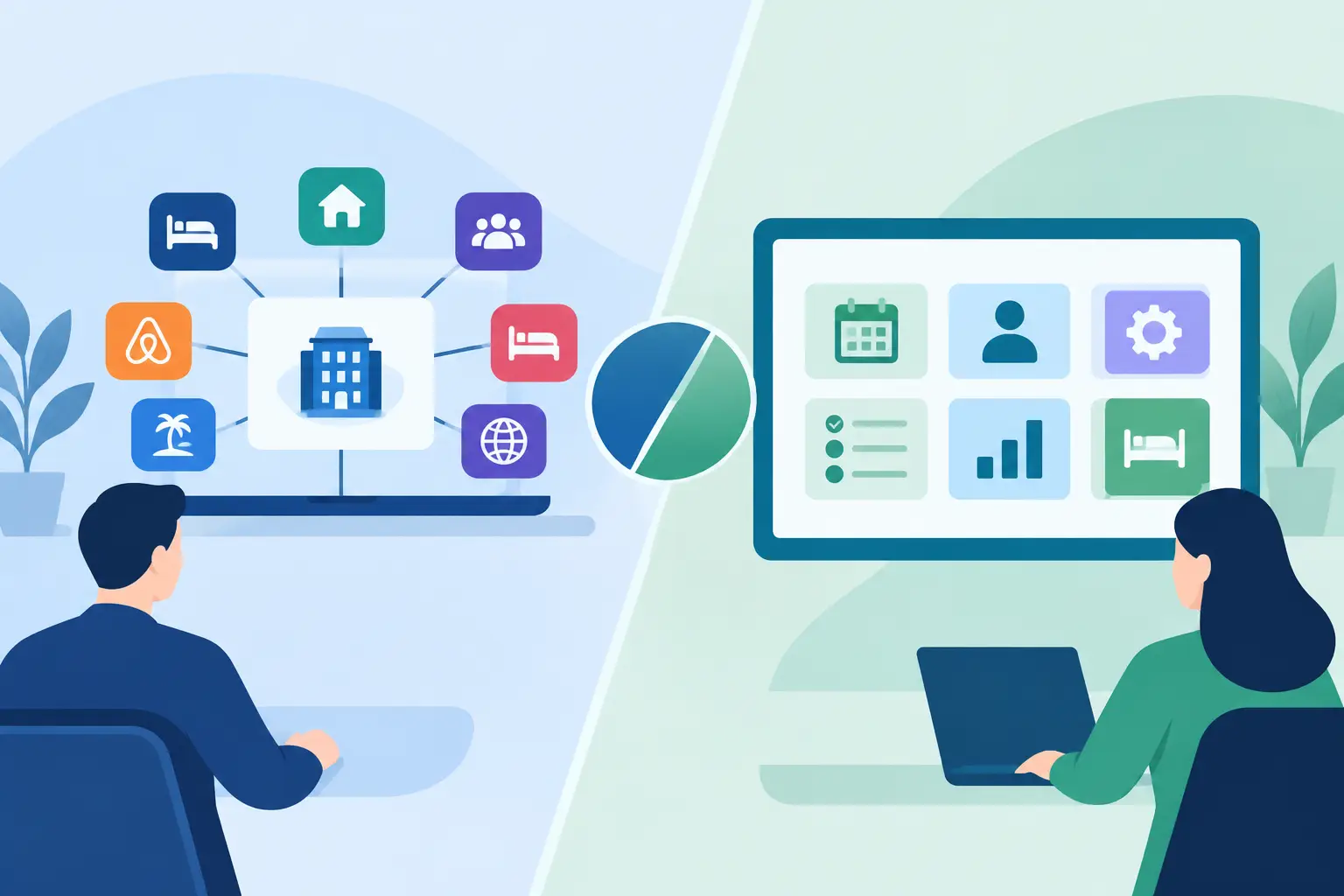
A channel manager can prevent an expensive double booking. It cannot, by itself, explain why one villa is underperforming, whether a turnover is at risk, or which operating decision is reducing margin. That is the practical difference in the channel manager versus operations platform discussion. One manages distribution. The other gives professional operators a system for seeing, directing, and improving the business behind every reservation.
For a small portfolio with a limited number of channels, that distinction may feel secondary. For a growing vacation rental, villa, or boutique hospitality operation, it becomes structural. Teams need more than synchronized availability. They need a reliable view of portfolio performance, operating exceptions, guest readiness, and the actions that require attention now.
What a channel manager is built to do
A channel manager connects a property management system or booking stack to online travel agencies and booking channels. Its core job is to synchronize rates, availability, restrictions, and reservation data across those channels.
That role is valuable. Without distribution synchronization, an operator may be manually updating calendars across Airbnb, Vrbo, Booking.com, direct booking sites, and regional channels. The result is slow response times, inconsistent pricing, and avoidable inventory conflicts. A channel manager reduces that administrative exposure and gives teams a more controlled way to distribute inventory.
Its design center, however, is the channel. Questions it handles well include: Is inventory open? Did the rate update publish? Did a reservation enter the system? Is a minimum-stay rule being applied correctly?
Those are essential distribution questions. They are not the same as operational intelligence questions. A channel manager generally does not provide a complete decision layer for the property business. It may show booking activity, but it is not necessarily built to connect that activity with cleaning status, maintenance risks, owner obligations, revenue targets, staff capacity, or property-level service performance.
Channel manager versus operations platform: the real divide
The difference is not simply feature count. It is the operating model each system supports.
A channel manager is transaction-oriented. It helps ensure that commercial information moves between systems and channels accurately. An operations platform is portfolio-oriented. It organizes fragmented information into a working view of what is happening across properties, where performance is changing, and what the team should address.
Consider a common scenario. A reservation arrives through an OTA, the calendar updates correctly, and the guest receives confirmation. From a channel management perspective, the workflow succeeded.
From an operations perspective, the reservation starts a chain of work. Is the property available and properly prepared? Has the cleaner been assigned? Is there an unresolved maintenance issue? Does the arrival create a pressure point for the guest services team? Is the booking rate aligned with the property’s revenue target? Has a recent cancellation pattern affected the month’s forecast?
The channel manager records the booking. The operations platform helps turn that booking into coordinated execution and usable management intelligence.
This distinction matters most when the portfolio grows beyond the point where a founder, general manager, or operations lead can hold the full picture in their head. Spreadsheets, chat threads, disconnected dashboards, and manual status checks may work temporarily. They do not create consistent operational control.
Why distribution data alone is not enough
Occupancy is visible. Operational drag is often not.
A portfolio can look healthy on a booking dashboard while quietly losing money through late turnovers, recurring maintenance failures, rate leakage, untracked owner usage, inconsistent guest preparation, or teams spending hours searching for status updates. Distribution tools are not failing when this happens. They are simply not designed to resolve the entire problem.
Professional operators need connected context. A revenue manager may need to compare booking pace with property readiness and demand signals. An operations manager needs to identify upcoming arrivals with unresolved tasks before they become guest issues. An owner or asset manager needs to see whether revenue performance is being achieved without rising service costs or deteriorating review quality.
That requires data to be organized around the property and its operating lifecycle, not just around the channel where the reservation originated.
An operations platform can create that layer by centralizing information from multiple systems and presenting it as a prioritized, decision-ready view. Rather than asking teams to search across tools, it highlights exceptions, exposes patterns, and supports accountability at the portfolio and property level.
When a channel manager is sufficient
A channel manager may be enough when distribution is the immediate problem and the operation remains simple. This is often true for an owner with a small number of properties, limited staffing, straightforward service standards, and no need for detailed performance oversight.
It can also be the right first investment for an operator whose availability and rate updates are still manual. Stabilizing distribution should come before adding another technology layer. There is little value in advanced analytics if base inventory data is inaccurate or reservation flow is unreliable.
The limitation appears when the business begins to scale. More properties introduce more variability: different owner rules, maintenance histories, seasonal demand patterns, turnover schedules, guest profiles, and revenue targets. More channels add commercial complexity. More staff and vendors add execution risk.
At that point, using a channel manager as the primary operating system can force people back into manual coordination. The business may have automated publishing while its core decisions remain fragmented.
When an operations platform becomes necessary
An operations platform becomes valuable when leadership needs to manage by exception rather than by constant follow-up. The shift is from asking, “Did the booking sync?” to asking, “What could compromise revenue, service, or readiness across the portfolio this week?”
This is especially relevant for villa operators and high-value stays, where one missed detail can have an outsized commercial impact. A late maintenance response or incomplete pre-arrival process is not merely an internal delay. It can affect guest satisfaction, reviews, repeat demand, team workload, and owner confidence.
The strongest platforms do not attempt to replace every specialist system. They sit above the operational stack as an intelligence layer. They consolidate the signals that matter, create visibility across functions, and help operators move from reactive updates to informed decisions.
For example, a platform may surface properties with weak booking pace relative to comparable assets, upcoming stays affected by open operational issues, or recurring points of friction that are increasing service costs. These are management conversations, not channel configuration tasks.
VillaPilot AI is positioned for this broader requirement: converting fragmented property and operational data into intelligence that supports portfolio control, revenue performance, and day-to-day execution.
The right question to ask before buying
Do not frame the decision as channel manager or operations platform unless you are choosing a first system for a very simple operation. In most professional portfolios, the two categories can work together.
The more useful question is: where is the constraint in the business?
If rates and availability are inaccurate across booking channels, start with distribution discipline. If reservations are synchronized but teams still struggle to identify risks, enforce standards, understand performance differences, or coordinate across properties, the gap is operational intelligence.
Assess the decision moments that currently depend on manual effort. Look at how long it takes to answer basic questions about property readiness, booking pace, revenue variance, unresolved issues, and task ownership. Then consider whether the data is trusted, current, and visible to the people who need it.
A technology stack should reduce the number of places a team must look before acting. It should not create another dashboard that reports activity without changing decisions.
Build for control, not just connectivity
Connectivity is necessary, but it is not the end state. A connected booking ecosystem still requires clear operating signals, accountable teams, and a shared view of the portfolio.
Choose a channel manager when the immediate priority is accurate distribution. Add an operations platform when the business needs intelligence across revenue, readiness, service, and execution. For operators managing valuable assets and demanding guest expectations, that second layer is often where scale becomes controlled rather than merely larger.
The most useful next step is to map one upcoming guest stay from booking to departure. Every manual handoff, missing status, and unanswered question in that journey points directly to the operational visibility your portfolio needs next.